
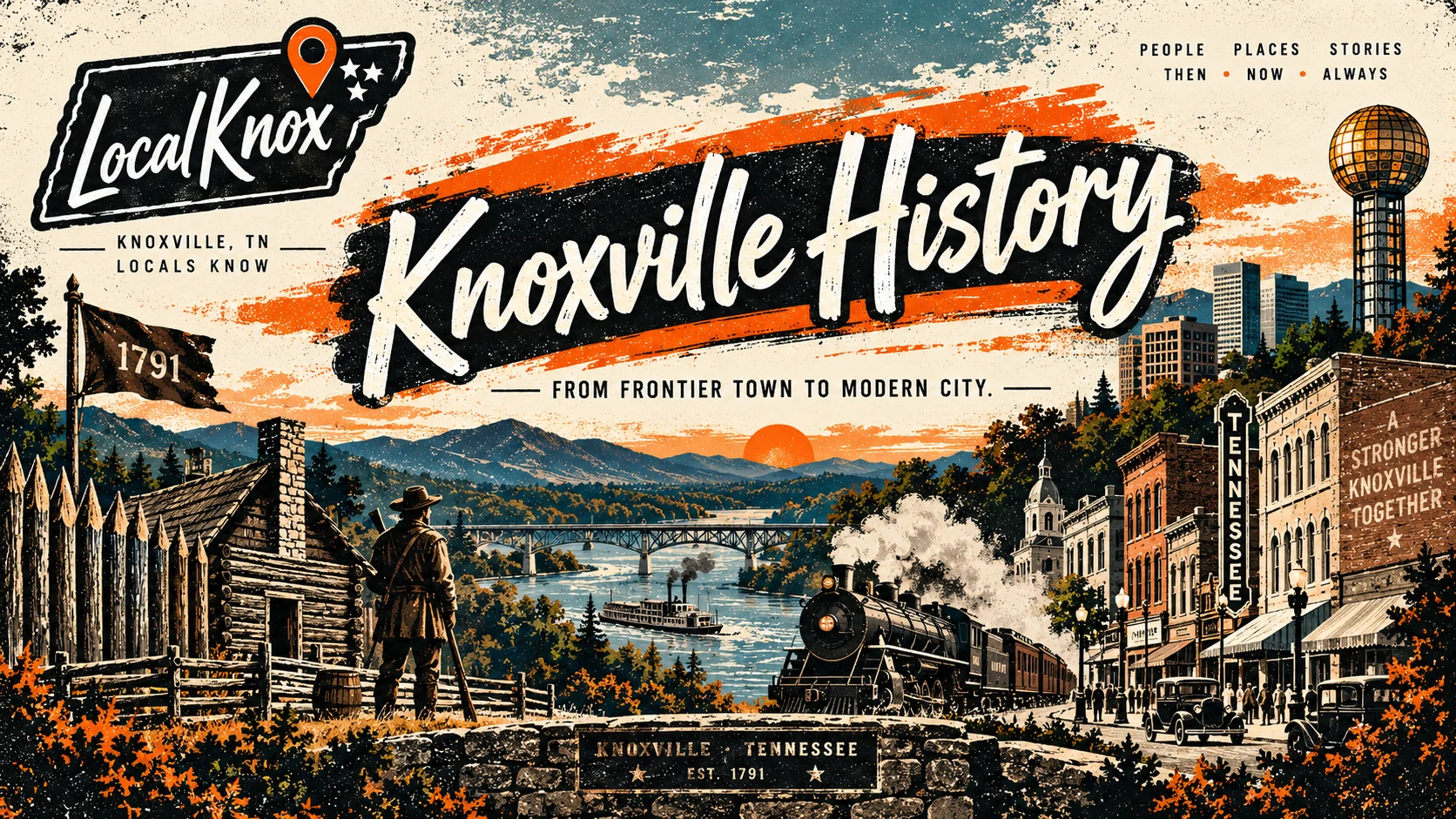
For decades after losing its status as Tennessee's permanent capital, Knoxville grew slowly. The arrival of the Tennessee School for the Deaf in 1844 gave the city an important statewide institution, but the event that truly changed Knoxville's economic trajectory came in 1855: the railroad.
Rail connections broke the city's dependence on slow river and wagon transportation. Goods could move farther and faster, merchants could reach new customers, and local resources suddenly had access to regional and national markets. After the Civil War, that network helped Knoxville become one of the South's important wholesale and distribution centers. Warehouses, factories, mills, rail yards, and commercial buildings reshaped downtown.
The surrounding region supplied timber, coal, iron, agricultural products, and a distinctive stone marketed widely as Tennessee marble. Though technically a type of limestone, the polished pink and gray stone became famous in monumental architecture. Knoxville's role in quarrying, processing, and distributing it helped earn the nickname Marble City.
Between 1870 and 1900, Knoxville's population expanded dramatically. Gay Street became a commercial spine lined with banks, department stores, offices, theaters, and wholesale houses. Railroads clustered around the north side of downtown and along industrial corridors. Streetcars later stretched the city's practical boundaries, allowing residential neighborhoods to grow farther from the old center.
Industrial growth also brought labor conflict, pollution, dangerous working conditions, and sharp class differences. The same economy that created fortunes for merchant families depended on thousands of workers in factories, warehouses, quarries, rail operations, and service jobs. Black Knoxvillians built churches, schools, businesses, newspapers, and professional networks despite the expanding restrictions of Jim Crow. Immigrants and migrants added new layers to the city's social life.
By the beginning of the twentieth century, Knoxville looked less like a frontier town and more like an ambitious industrial city. Its skyline, streets, and neighborhoods reflected the power of rail transportation and extractive industries. The warehouses and commercial blocks preserved in parts of downtown and the Old City remain some of the clearest physical traces of that era.
This article is original LocalKnox editorial writing based on historical sources; it is not copied from the linked material.