
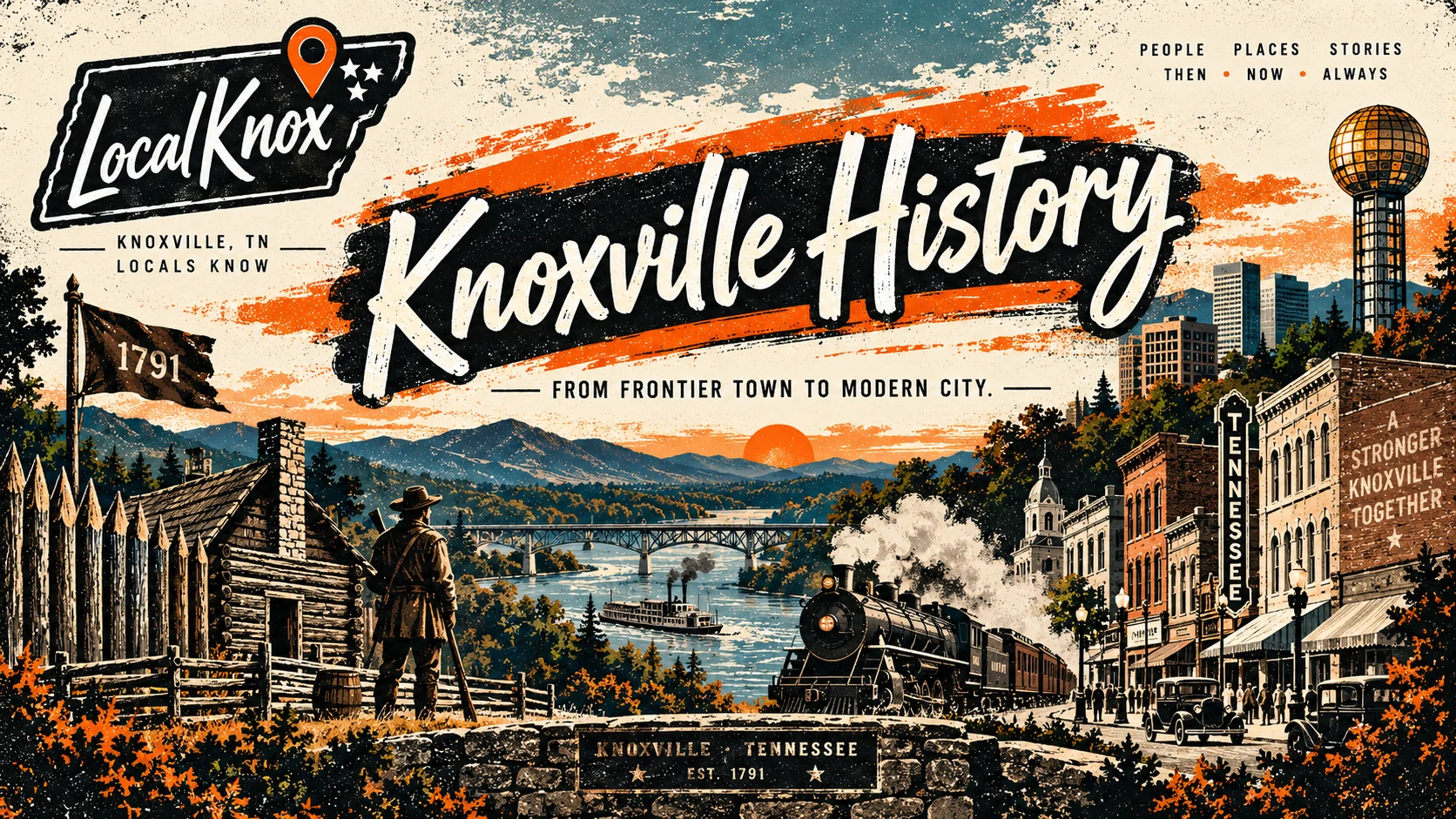
Long before there was a street grid called Knoxville, the meeting of rivers and valleys in East Tennessee was part of a much older human landscape. Cherokee communities lived throughout the region, using the river corridors as routes for travel, trade, food, and diplomacy. The French Broad and Holston rivers, which join to form the Tennessee River, were not empty frontiers waiting for newcomers. They were part of a homeland with its own political geography, towns, hunting grounds, pathways, and relationships stretching across the southern Appalachians.
By the late eighteenth century, that landscape was being transformed by pressure from the new United States. Revolutionary War veterans received land grants, speculators surveyed property, and families crossed the mountains in growing numbers. James White, a Revolutionary War captain from North Carolina, established a fortified homestead in the area in the 1780s. His settlement became one of the anchors around which a more formal town would later be organized.
The Treaty of the Holston, negotiated in 1791 between representatives of the United States and Cherokee leaders, is inseparable from Knoxville's origin story. William Blount, governor of the Southwest Territory, represented the federal government. The treaty attempted to define boundaries, regulate relations, and formalize American claims in the region. From the perspective of U.S. officials, it created a framework for government and settlement. From the Cherokee perspective, it came amid a long period of land loss, military pressure, and repeated attempts to preserve sovereignty.
A useful way to understand Knoxville's beginning is to hold both facts at once: the city was deliberately founded as a new political and commercial center, and that founding took place within an Indigenous homeland already shaped by generations of Cherokee life. Modern Knoxville still carries evidence of both stories in place names, archaeological sites, historic markers, museum collections, and the river itself.
That broader frame matters because a city's history does not begin with the moment a surveyor draws streets on paper. Knoxville's formal birth in 1791 was a turning point in a much longer regional story. The river valleys that made the site attractive to settlers had already made it important to Native communities. The same geography that later supported ferries, railroads, factories, highways, and recreation first supported Native travel and exchange.
Today, interpreting Knoxville's earliest era responsibly means moving beyond the old frontier myth in which settlers appear on an empty stage. The stage was occupied. The story includes diplomacy, conflict, adaptation, forced change, and the persistence of Cherokee people and culture. Knoxville's next chapter began in 1791, but the land's human history was already centuries deep.
- City of Knoxville — History of the City
- City of Knoxville — Cherokee Heritage Day / Treaty of the Holston context
This article is original LocalKnox editorial writing based on historical sources; it is not copied from the linked material.